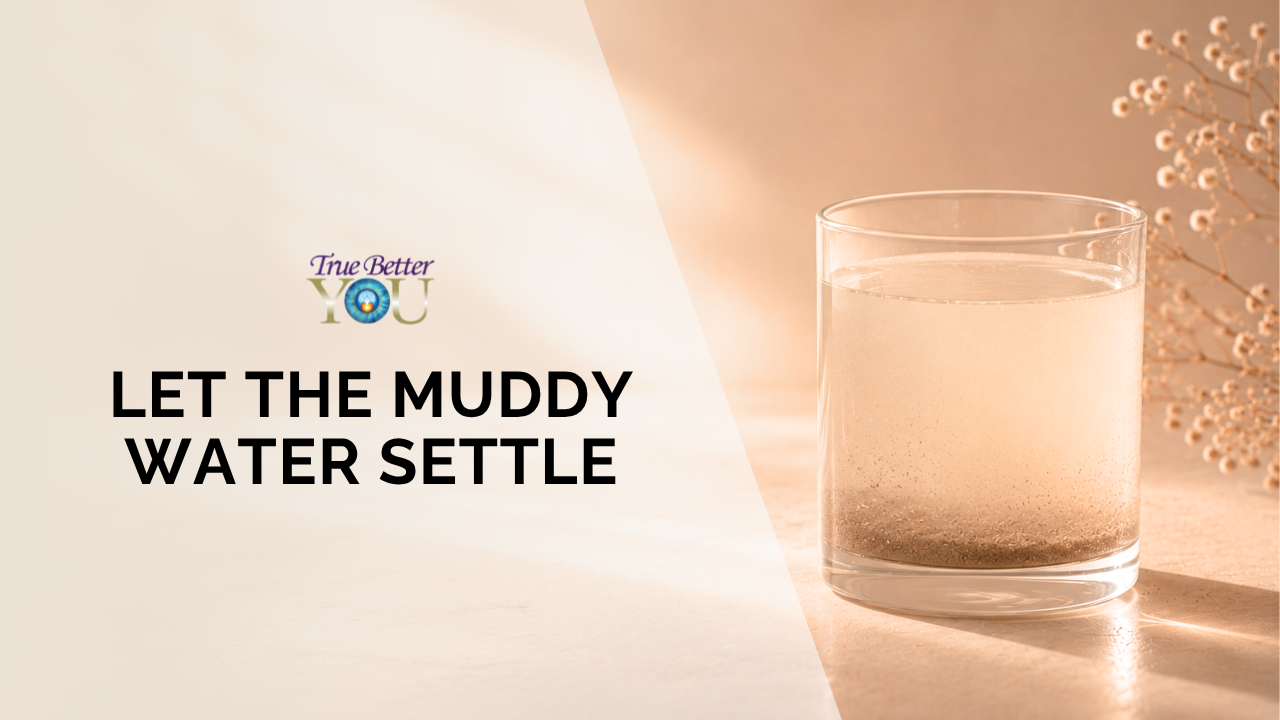
Let the muddy water settle
By Simone Claridge · True Better You
I came back from China with something I didn't expect.
Not a new method. Not more knowledge. A kind of settling. A quietness I could feel in the body before I could describe it with words.
And immediately — decisions were waiting.
Not dramatic ones. Daily ones. How to organize the work, what to say yes to, what to release, where to put the energy. The same questions that had felt pressured and sticky before I left now felt different. I found myself less pulled. Less attached to particular outcomes. More willing to wait and see what became clear.
I noticed I had changed in some way I couldn't fully account for yet.
And it raised a question I want to explore with you — one that I think most of us face, especially after any significant moment of deepening: How do you know what decision to go by?
What the reference framework does to decisions
Grandmaster Pang Ming is very precise about this in the Hunyuan Entirety Theory.
He describes what he calls the reference framework — the accumulated information stored in yiyuanti from everything we have experienced, learned, been told, and absorbed from society and family. It is not neutral. It is shaped by fear, desire, social conditioning, the expectations of others, and the stories we have built about who we are and what we are allowed to do.
The critical point: the reference framework is not the True Self.
When we make decisions from the reference framework — from money, from what others expect, from the urgency others are generating, from the need to fill space and feel productive — we are not actually deciding. The reference framework is deciding for us. And because it is fixed and limited by past information, it can only reproduce what it already knows.
Dr. Pang names it directly: "The functioning of yiyuanti is fixed and limited by the reference system within a certain, relatively narrow range. And so people live through an inflexible, fixed, and distorted self."
Most of the decisions we agonize over are decisions made inside that distortion. We think we are choosing. We are being chosen by our own conditioning.
Two texts, thousands of years old — and why they still reach us
At the retreat in China, Teacher Xu referred to the Tao Te Ching.
Not as a historical document. As a living description of what was happening in the room.
This is something worth sitting with for a moment — because it points to something important about classical texts in general.
The Tao Te Ching was written approximately 2,500 years ago. But Dr. Pang Ming, in the Hunyuan Entirety Theory, draws from an even more specific ancient source: the Nei Ye — Chapter 49 of the Guan Zi, written around 350 BCE. The Nei Ye — which translates as Inner Cultivation or Inward Training — is one of the oldest texts in existence describing the practice of quieting the heart-mind to receive qi and dao. It predates much of the Daoist tradition as we know it, and its influence can be felt throughout the Tao Te Ching, traditional Chinese medicine, and Zhineng Qigong itself.
Dr. Pang quotes it directly: "This qi cannot be blocked with power but it can be kept with de. It cannot be called with voice but it can be held by mind. When you are quiet, you can get it. When you worry, you lose it. Fame and fortune, desire and knowledge, strong emotions of all kinds — all this will bring error to your heart. Be quiet without all of this in your chest. Then you will stay honest and upright. This is wu wei."
Why does a text written 2,350 years ago describe what is happening in a practice session today with such precision?
Because it does not describe a historical moment. It describes the actual mechanics of how consciousness and qi function. Those mechanics have not changed. Yiyuanti worked the same way 2,500 years ago. The reference framework created distortion then as it does now. And quietness allowed clarity then as it does now.
The text is not a museum piece. It is a map that remains accurate because the territory it describes is permanent.
This is why Teacher Xu quotes the Tao Te Ching in a retreat in 2025. And why Dr. Pang Ming builds a new science of life on the foundation of texts written millennia before him. The ancient and the contemporary are not in tension. They are confirming each other.
The Tao Te Ching, Chapter 15:
Who can wait while the muddy water settles and becomes clear? Who can remain still while the moment of action arrives on its own?
Chapter 48:
In pursuit of Tao, every day something is released. Release and release again — until non-action is reached. Through non-action, nothing is left undone.
The Nei Ye, thousands of years earlier, said the same thing first: when you are quiet, you can get it. When you worry, you lose it.
We are not accustomed to the idea that good decisions come from releasing. We are trained to gather more information, think harder, consult more people. Both the Nei Ye and the Tao Te Ching say the opposite: the right action emerges from releasing — releasing attachment to outcome, releasing the reference framework's grip, releasing the urgency to decide before clarity has arrived.
The tribe chief and the ocean
Here is how I experience this — through two images that came together during the retreat.
The first: imagine I was a tribe chief sitting on top of a mountain, above the clouds, overlooking the whole country. From that position I copuld see all movements — where people are going, what directions are forming, what is building and what is dissolving. I are not alert and aware. I could see everything. But I was not moved by any of it. I simply observed., registered, and traced the trail of each movement without being captured by it. From that height — completely detached, completely free — the right move becomes visible. Not thought out. Simply visible.
This is the True Self functioning as master. Observing before directing.
Dr. Pang describes this precisely. The clarity of yiyuanti is called xu ling ming jing — four qualities held together. Xu means empty but not empty. Ling refers to the effective speed of yiyuanti in precisely receiving and sending information. Ming means pure and clear. Jing means quiet.
He writes: "This clarity of yiyuanti depends upon the quality and quantity of qi to nourish it, as well as its own characteristic stability. Xu ling ming jing is generally enhanced by degrees of smooth and regular movement, including calm thinking, and is disturbed by inconsistent movement, such as panic. In the midst of disturbance, calm and regular movement can help equalise the irregular movement and so reduce the disturbance."
This is worth sitting with. Dr. Pang is precise that simply trying to empty the mind is not always the easiest route. He notes that some traditional qigong seeks to reduce disturbance through emptying the mind and thinking nothing — but that this is not where most people should begin. Zhineng Qigong instead stresses regular, smooth movement as the way to calm what is irregular. Not forcing stillness onto a panicked system. Meeting disturbance with steady, repeated motion until the system naturally settles.
The tribe chief on the mountain is not blank or empty-headed. The chief is xu ling ming jing — receiving everything, processing it with precision, clear, and quiet. That clarity is not achieved by refusing to think. It is achieved through smooth, regular practice that gradually steadies what is irregular.
The second image: you are the ocean. The waves are the qi movements around you — other people's decisions, financial pressures, family expectations, the urgency of what seems to need an answer right now. The wave is real. It moves. But it does not affect the ocean. It is the ocean expressing itself.
The danger is staying on the surface. On the surface, every wave pulls you. Every urgency feels like something you must respond to. And on the surface — you evaporate. You lose yourself to the constant motion of things that pass.
You need to sink.
Not escape. Sink — to where the water is deep and still. Where the waves above are visible but cannot reach you. Where clarity is simply the nature of the water.
When the power of the distorted reference framework is reduced, yiyuanti's xu ling ming jing — its bright and effective purity — is better able to shine. The True Self was never absent. It was obscured by the turbulence on the surface. And the way back is not forced emptiness. It is steady, smooth, regular practice — letting calm movement gradually equalize what panic had disturbed.
What this means practically
A job decision. A relationship. A health situation. A choice about where to put your energy.
The question is not: what does the reference framework think I should do? What do others expect? What is safe? What fills the space?
The questions that arise from depth are different:
When I am completely still — what do I actually know? Which direction feels alive — not exciting, not safe, but alive? What would I choose if no one was watching and nothing was at stake financially, just for one moment? Is this coming from my True Self, or from a wave I got caught in?
You don't always get an immediate answer. Sometimes the muddy water takes time to settle. That is not a failure of clarity — it is clarity arriving on its own schedule. Chapter 16 of the Tao Te Ching: "Not knowing the eternal leads to reckless action — and disaster."
Reckless action is the decision made before the water has cleared. Before you have returned to the root. Before stillness.
The decision that comes from depth — from the tribe chief's mountain, from the ocean floor, from the quiet place where the True Self is already clear — that decision does not feel like a decision. It feels like seeing something that was always there.
A practice — if you have it
N...
Let the body settle. Let the urgency of the question soften for just a moment.
Feel the depth beneath the surface. The ocean beneath the waves.
From there — not from thinking — notice what you already know.
Don't act yet. Just see.
Stay there for a few breaths.
The moment of action will arrive on its own.
Every morning a small group gathers to chant N together — daily, 8–9am EST. No teaching, no performance. We come as we are. We come for what we truly are. And we stay conscious in it. → Join the Daily N-Tone Session
With Mingjue LOVE and warmth, Simone
Sources and lineage: Nei Ye (Inner Cultivation) — Chapter 49 of the Guan Zi, written approx. 350 BCE. Free translation available at Project Gutenberg: gutenberg.org/ebooks/38585. Scholarly edition: W. Allyn Rickett, Guanzi: Political, Economic, and Philosophical Essays from Early China, Princeton University Press. Tao Te Ching — Laozi, approx. 500 BCE. Simone's reference translation. Grandmaster Pang Ming — Hunyuan Entirety Theory, sections on True Self, reference framework, wu wei, dao de. Full text available through Zhineng Qigong organizations. Teacher Xu — direct transmission, Luofu Mountain retreat, May 2026. Teacher Wei Qi Feng — Mingjue Gongfu 2026.
Stay connected with news and updates!
Join our mailing list to receive the latest news and updates from our team.
Don't worry, your information will not be shared.
We hate SPAM. We will never sell your information, for any reason.